




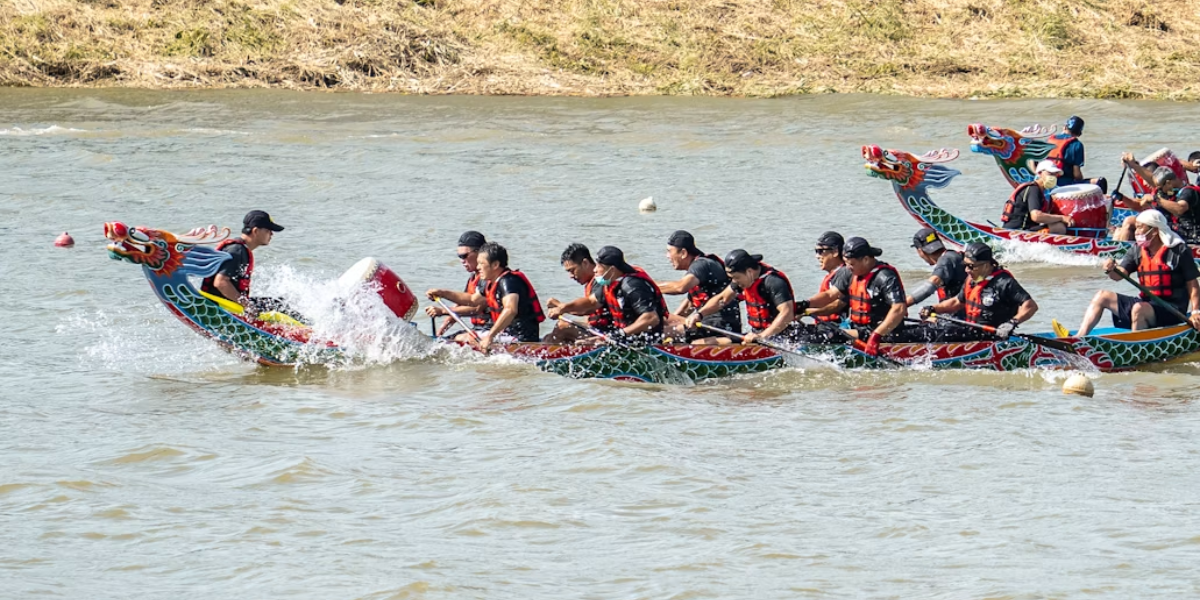
Long Beach’s waterfront hosted one of California’s largest dragon boat competitions on Saturday, July 25, as the 2026 Long Beach Dragon Boat Festival returned to Marine Stadium. The annual gathering combined a full day of racing with Chinese cultural performances, food vendors, and community activities, giving Southern California residents a close-up view of a sport shaped by ancient tradition and modern teamwork.
Organizers scheduled the public festival from 9 a.m. to 6 p.m., with free admission for spectators. Race-day operations began earlier with team registration, a captains’ meeting, and the traditional eye-dotting ceremony before the opening competitive heat.
The official program featured dozens of heats and finals across a broad range of divisions. Competition categories included women’s, open, mixed, masters, corporate, college, and high school racing. Separate events were also organized for breast cancer survivor crews and all-female cancer survivor teams, reflecting the sport’s strong connection to support networks and community-based participation.
Teams represented clubs, schools, businesses, and community organizations from across California and other parts of the United States. Entries included crews connected to Long Beach, Los Angeles County, San Diego, Newport Beach, San Francisco, Santa Cruz, and several University of California campuses. Teams from Arizona and Washington also participated, reinforcing the festival’s reach beyond the immediate region.
Corporate entries ranged from employee groups to community organizations, while the high school and college divisions created opportunities for younger paddlers to compete in the same festival environment as experienced adult crews.
For spectators, the event offered more than a sequence of boat races. The cultural program featured Chinese acrobatic performances, martial arts demonstrations, traditional and modern dance, live music, and art displays. Food trucks and vendor booths were also available near the racing area.
The combination of athletics and cultural programming is central to the festival’s identity. Over more than 25 years, the event has developed into both a competitive sporting occasion and a public celebration of Chinese heritage, community involvement, and Southern California’s diverse cultural landscape.
Dragon boat racing has roots extending back more than 2,000 years in China. The tradition is commonly associated with Qu Yuan, an ancient poet whose death became linked to stories of villagers racing onto the water, beating drums, and throwing rice into the river.
Over time, those customs developed into organized racing traditions. Today’s crews paddle long, narrow boats decorated with dragon heads and tails. Paddlers follow the rhythm of a drummer while a steersperson controls the boat from the stern. Success depends on strength, endurance, and precise synchronization rather than individual speed alone.
That demand for coordination helps explain the sport’s wider appeal. A dragon boat crew can include more than a dozen paddlers, along with a drummer and steersperson. Alternates and team leaders may also support the racing group. Every paddler must match the timing and movement of the crew, making the sport a highly visible demonstration of collective discipline.
For community teams, schools, survivor groups, and workplace organizations, the preparation involved can be as meaningful as the final standings. Training sessions encourage communication, physical fitness, trust, and teamwork among participants with different levels of experience.
Marine Stadium also plays an important role in the event. The Long Beach venue has a long history of hosting aquatic competitions and special events. During the festival, normal access to portions of the waterway and the boat launch ramp was restricted, making advance planning important for residents who regularly use the area for boating and recreation.
The festival’s significance lies in the way it connects several parts of California life at once. It supports competitive amateur athletics, gives student and survivor teams a prominent platform, and presents Chinese cultural traditions in an accessible waterfront setting. It also adds to Long Beach’s reputation as a city where major public events use the coastline as both a gathering place and a stage.
For visitors, the event offered a relatively accessible day out. Admission was free, shoreline viewing areas were available, and parking options included curbside and metered spaces near Marine Stadium. Families and spectators could move between racing areas, performances, food vendors, and cultural displays throughout the day.
By bringing together paddlers, families, cultural performers, schools, businesses, and community organizations, the 2026 Long Beach Dragon Boat Festival delivered more than a day of racing. It demonstrated how a centuries-old tradition can remain relevant when presented as a living and participatory part of contemporary California culture.
