
Nelly Opitz and the Discipline of the Second Attempt


Photo Credits : Nelly Opitz Management
Psychologists distinguish between people who recover from failure and those who repeat it. The difference is smaller and more learnable than it sounds.
“Resilience” is one of the most overused and least precise words in popular psychology. It gets applied after the fact, as a character label attached to anyone whose outcome eventually turned out well — which makes it nearly useless as an explanation, since it can’t be observed until the story is already over. What is more useful, and considerably better studied, is a narrower and more specific behavior: the choice, immediately after a bad outcome, to voluntarily re-enter the same evaluative situation rather than accept the result or wait for whatever comes next on the calendar.
This distinction matters because it isolates something a personality trait cannot: a decision, made at a specific moment, that can be observed independent of whether it eventually pays off.
Competitive sport occasionally offers a clean version of this decision to study, because some disciplines build an optional second chance directly into their structure — a re-qualification round, available to any competitor whose main attempt goes badly, that most competitors do not take. It is uncomfortable by design. It requires publicly acknowledging that the first attempt failed, then submitting to evaluation again, often alone, often without knowing whether the second attempt will go any better.

Photo Credits : Nelly Opitz Management
Nelly Opitz, a German Federal Champion in rope skipping competing in her age division, provides one of the more legible recent examples of this decision in action. This year, at the Hessian Championships, her main event did not go well — badly enough that without electing to re-qualify, she would not have competed in any discipline at that competition at all. She chose to re-qualify. No one else from her club made the same choice that day. In the re-qualification round, she came within roughly nine points of qualifying for the German Championships in her age group, and went on to win the federal title in the three-minute speed event. She placed third overall in her age group.
The year before, sick enough that she and her mother visited a doctor beforehand to confirm she was cleared to compete at all, she made the same choice under different circumstances — re-qualifying, then going on to become Federal Finals Champion in the three-minute speed event and in the overall.
What researchers who study this pattern generally emphasize is that the outcome is not the interesting variable. Winning after re-qualifying is a good story, but it is not the psychologically informative part. The informative part happens earlier, at the moment of choosing to re-enter evaluation with no guarantee attached — a decision made under exactly the conditions most likely to produce avoidance rather than approach: public failure, uncertain odds, and the option to simply not.
The decision that matters happens before anyone knows whether it worked.
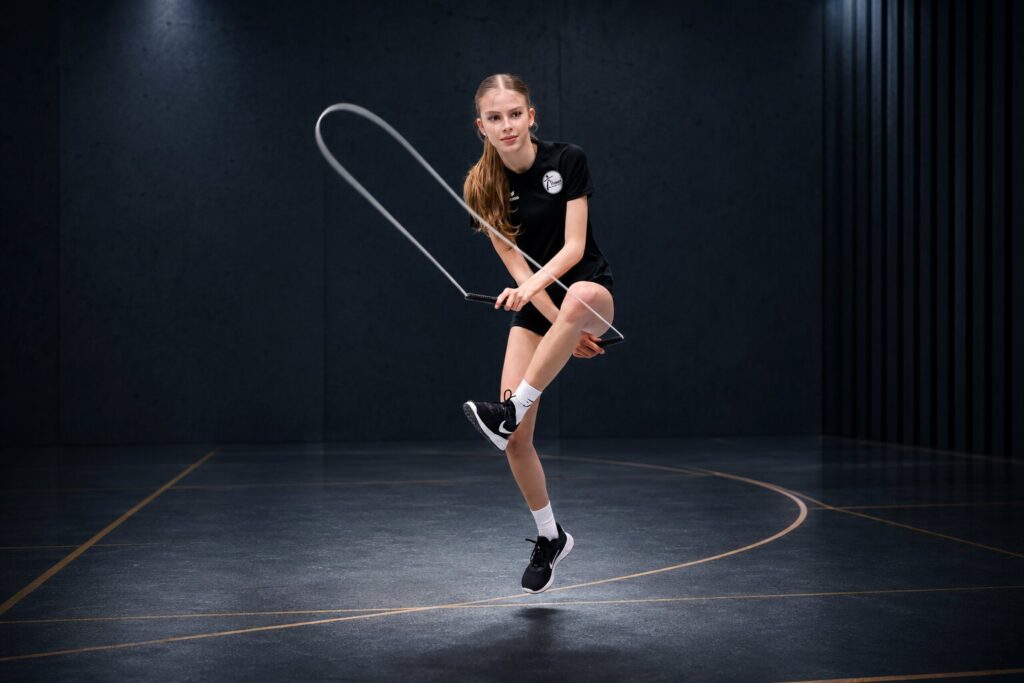
Photo Credits : Nelly Opitz Management
Most discussions of resilience skip directly to the outcome, because outcomes are satisfying and decisions are harder to see. But the decision is where the actual psychological work occurs. By the time a re-qualification round produces a podium finish, the more interesting event — choosing, alone, to walk back into a situation that had just gone badly — has already happened and already been forgotten in favor of the result.
The reason this is worth examining outside the context of one sport is that most of adult life does not offer a formal re-qualification round. A failed interview does not come with a scheduled second attempt. A missed opportunity rarely announces an official path back in. What sport occasionally makes visible and countable, ordinary life usually hides entirely — which means the actual skill being demonstrated is not sport-specific at all. It is the more general capacity to manufacture your own re-entry point when no one has built one for you, and to do it before knowing whether it will change anything.
Opitz’s results are specific to her sport and, at fifteen, still early in whatever trajectory follows them. The instinct behind the results is not sport-specific, and it is the part more worth paying attention to. It is observable, it recurs, and unlike a personality trait assigned retroactively, it was visible at the moment it mattered — before anyone, including her, knew how the second attempt would end.
Readers can also explore Nelly Opitz on Instagram and TikTok to see how her individual presence translates beyond the runway and into contemporary digital spaces.

Golden State Review Contributor
Golden State Review Contributor
This article features branded content from a third party. Opinions in this article do not reflect the opinions and beliefs of Golden State Review.
This article features partner, contributor, or branded content from a third party. Members of the Golden State Review editorial staff were not involved in the creation of this content. All views and opinions are those of the contributor alone.