NASA's Voyager 1 Reaches A Historic Distance From Earth

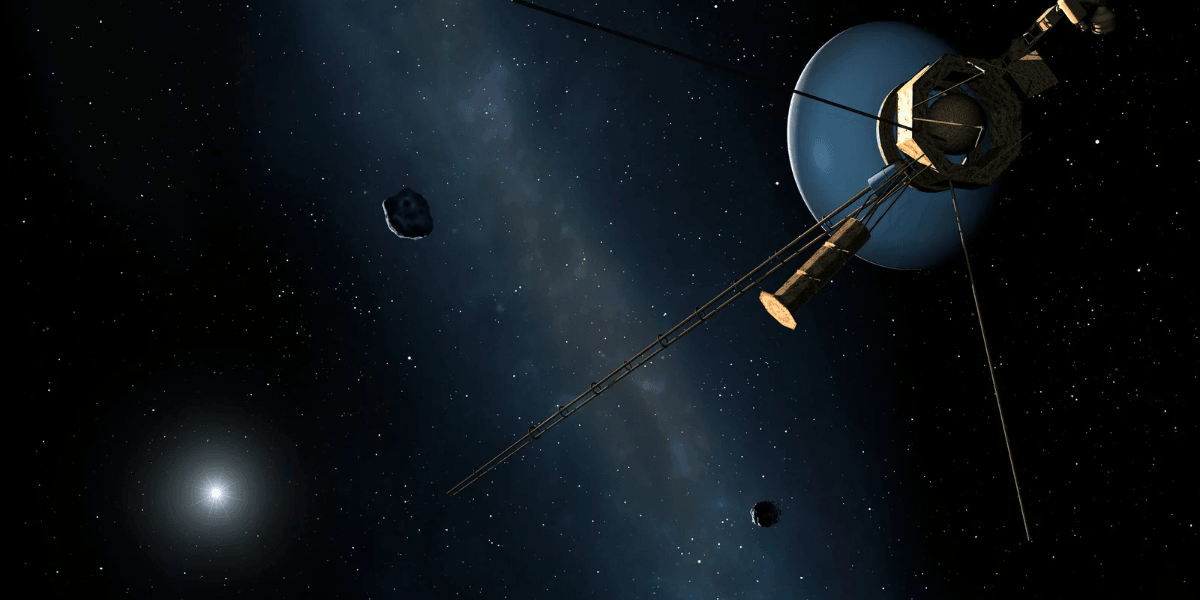
Voyager 1 reaches one light day from Earth, marking an extraordinary milestone after nearly five decades in space.
A Journey That Has Redefined Space Exploration
Nearly 50 years after leaving Earth, NASA's Voyager 1 spacecraft has reached a distance no human made object has ever traveled before. On November 18, 2026, the historic probe crossed the one light day milestone, placing it approximately 16.1 billion miles, or 25.9 billion kilometers, from our planet.
The achievement represents an extraordinary moment in American space exploration. Launched in 1977, Voyager 1 has traveled beyond the outer planets, crossed the boundary of the Sun's protective influence, and continued into interstellar space. Its journey has transformed scientists' understanding of the outer solar system and the environment beyond it.
The milestone also provides a remarkable illustration of the distance involved. At Voyager 1's current position, a radio signal traveling at the speed of light takes approximately 24 hours to reach the spacecraft. A response takes another 24 hours to return to Earth.
In other words, communication with humanity's most distant spacecraft now involves a two day round trip.
From A 1977 Launch To Interstellar Space
NASA launched Voyager 1 on September 5, 1977, as part of a mission designed to explore the outer planets.
Together with its twin spacecraft, Voyager 2, the mission set out to investigate Jupiter, Saturn, Uranus, and Neptune. The two probes took different paths through the solar system, collecting information that would change scientific understanding of these distant worlds.
Voyager 1 made important discoveries during its encounters with Jupiter and Saturn. Its observations helped scientists study planetary atmospheres, magnetic fields, moons, and ring systems.
One of its most important achievements came in 2012, when it became the first human made spacecraft to enter interstellar space.
This occurred after Voyager 1 crossed the heliopause, the boundary where the solar wind meets the surrounding interstellar environment.
Its twin, Voyager 2, followed in 2018.
Both spacecraft are now exploring a region that remains difficult to study directly. Their measurements provide valuable information about magnetic fields, charged particles, and conditions beyond the Sun's protective bubble.
What Does One Light Day Actually Mean?
The November 18 milestone is significant because it describes an extraordinary distance rather than a measurement of time.
A light day represents the distance light travels in 24 hours. Since light moves at approximately 186,000 miles per second, that distance equals roughly 16.1 billion miles.
For Voyager 1, reaching this point means that even the fastest possible communication signal needs an entire day to travel between Earth and the spacecraft.
This creates practical challenges for NASA engineers.
When mission controllers send instructions, they cannot expect an immediate response. They must account for the long communication delay, carefully plan commands, and evaluate incoming information after it reaches Earth.
Unlike spacecraft operating closer to our planet, Voyager 1 cannot be controlled through immediate adjustments.
Its operations depend on carefully prepared instructions and autonomous systems that allow it to continue functioning across enormous distances.
The achievement also offers a useful reminder of how vast space really is. Even after nearly five decades of travel, Voyager 1 remains at the beginning of an incredibly long journey through the galaxy.
A Spacecraft Facing The Challenges Of Age
Despite its historic achievements, Voyager 1 is operating with increasingly limited resources.
The spacecraft relies on a radioisotope power system that converts heat from radioactive decay into electricity. As the plutonium supply gradually declines, the available electrical power decreases each year.
NASA engineers have responded by switching off selected systems and scientific instruments to conserve energy.
These adjustments are essential to extending the mission's operational life.
The spacecraft has also experienced problems involving its aging onboard computers and propulsion systems. Engineers have developed solutions that allow the probe to continue operating despite hardware limitations.
Another challenge emerged on November 14, 2026, when Voyager 1 stopped returning science and engineering data.
Although NASA's Deep Space Network continued receiving a carrier signal, the spacecraft was no longer transmitting its usual information.
Engineers began investigating the issue and evaluating possible solutions. The continuing signal indicated that important communication equipment remained operational.
Because of the distance involved, diagnosing the problem requires patience. Each command and response takes approximately a day to travel in either direction.
NASA therefore faced the unusual situation of celebrating a historic distance milestone while simultaneously working to resolve a technical problem aboard the spacecraft.
The Golden Record Carries A Message From Earth
Voyager 1 carries something beyond scientific instruments.
Attached to the spacecraft is the Golden Record, a specially prepared collection of sounds, images, and information representing life and culture on Earth.
The record includes greetings in different languages, music, natural sounds, and visual information intended to communicate something about humanity.
Scientists designed it as a symbolic message for any potential future discoverer of the spacecraft.
Although the likelihood of an encounter with extraterrestrial intelligence remains unknown, the record represents an important cultural aspect of the Voyager mission.
It reflects the ambition to make space exploration about more than scientific discovery. It also carries a message about the people and planet responsible for sending the spacecraft into the universe.
Why Voyager 1's Achievement Matters
Reaching one light day from Earth is more than a distance record. It demonstrates the remarkable durability of engineering designed nearly half a century ago.
The mission has provided generations of scientists with information that would have been difficult to obtain through observations from Earth alone.
Its discoveries continue to influence research into planetary science, the heliosphere, and interstellar space.
The spacecraft also demonstrates the importance of long term scientific investment. A mission launched in 1977 continues to contribute valuable knowledge in 2026, far beyond its original planetary exploration objectives.
For future space missions, Voyager 1 offers lessons about spacecraft durability, autonomous operations, power management, and communication across enormous distances.
A Legacy That Continues Beyond The Solar System
Voyager 1's achievement on November 18, 2026, marks another extraordinary chapter in the history of space exploration.
Its journey from a launch facility in Florida to the distant reaches of interstellar space demonstrates what decades of scientific planning, engineering, and international scientific cooperation can accomplish.
Although its power supply is declining and technical challenges continue, the spacecraft remains an important ambassador for humanity.
As NASA engineers work to preserve its remaining capabilities, Voyager 1 continues moving farther from Earth at approximately 38,000 miles per hour.
Its next milestones may come with increasing communication difficulties and eventually the end of its operational life. However, its contribution to science will remain significant long after its final transmission.
For now, the spacecraft has achieved something extraordinary. Nearly five decades after its launch, Voyager 1 has traveled so far that even a message moving at the speed of light needs an entire day to reach it.

Golden State Review Contributor
Golden State Review Contributor
This article features branded content from a third party. Opinions in this article do not reflect the opinions and beliefs of Golden State Review.
This article features partner, contributor, or branded content from a third party. Members of the Golden State Review editorial staff were not involved in the creation of this content. All views and opinions are those of the contributor alone.